A Look Into the History of the Minecraft Server List

I clicked through a server list last week without thinking about it at all. Typed in a search, scrolled past a dozen banners, picked something that looked cozy, and joined. It's such an ordinary little ritual now that it's easy to forget someone had to invent it. There was a first list. A first server on that list. A first person who thought "people should be able to find each other" and built something to make it possible. I went looking for that story, and it turned out to be a lovely one to sit with on a quiet evening. ✨
The First List There Ever Was
Multiplayer wasn't part of Minecraft at launch. Notch added it just fourteen days after the game's initial release in 2009, and the game's website put up a simple list not long after, a basic page with whatever servers existed at the time. There weren't many. The entire player base was around 274 people, and only a handful of servers had anything to connect to.
The oldest name on that early list is nerd.nu, originally known as the Reddit Public Server. It went live on June 10, 2009, and was added to the official list just two days later, on June 12. That makes it one of the first servers anyone could actually find and join, and the oldest continuously active community in Minecraft's history. It's still running today, which feels like a small miracle when you think about how much has changed around it.
The following month brought something else new: the first modded server, built by a player known as JTE in July 2009. It didn't last long. But it planted an idea that would define the next decade of multiplayer, that a server could be more than vanilla survival if someone was willing to build the tools for it.
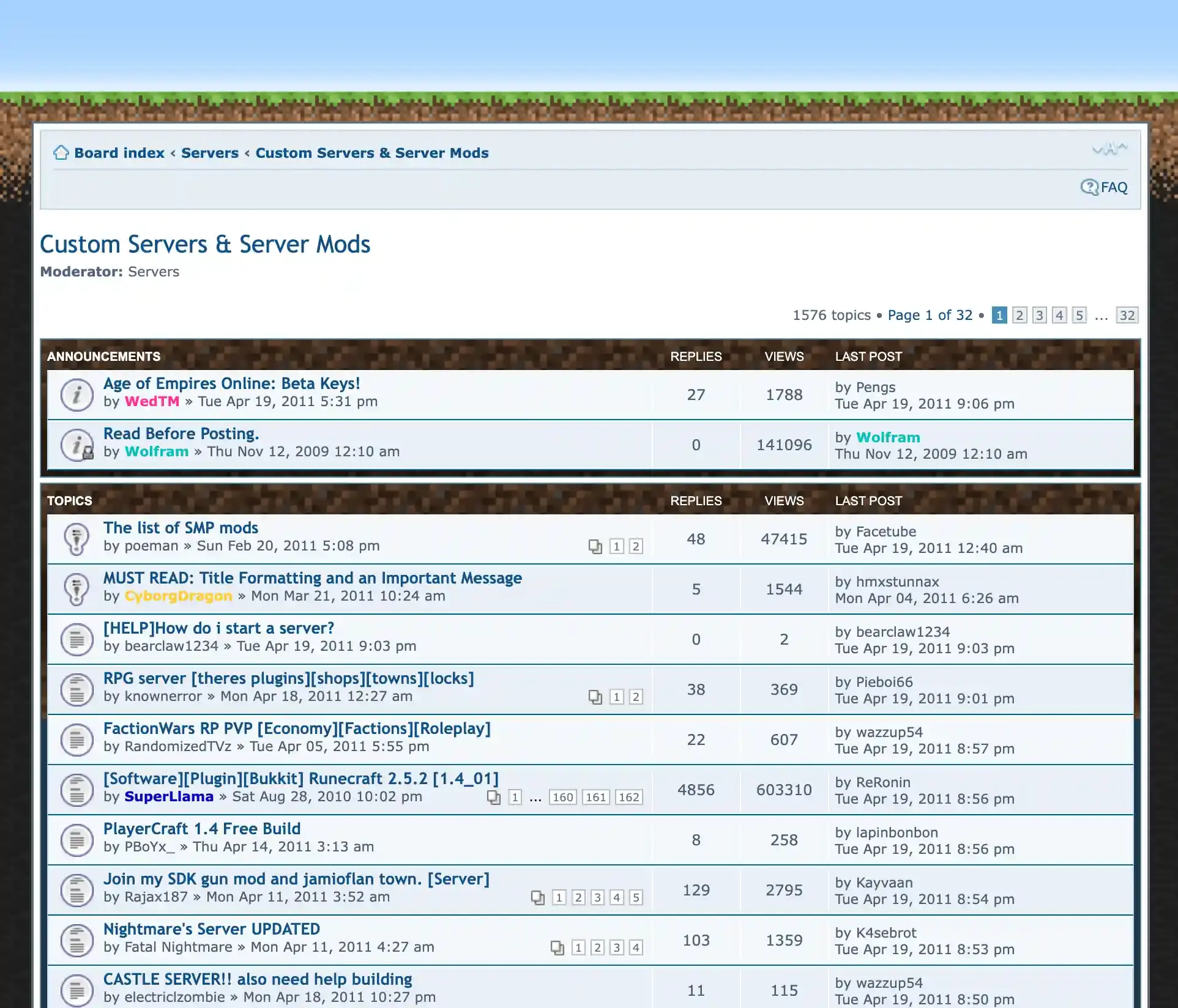
By August 2010, the official Minecraft Forum had its own server listing page, giving the community a proper hub for the first time. That's where servers like Novella and MinecraftOnline found their early audiences.
The Official Minecraft Forum Server Sections (2010-2012)
For a couple of years, the forum was the whole universe. If you wanted your server found, you posted a thread. A good one included your IP address, your rules, sometimes even your hardware specs, as if players needed to know exactly what they were connecting to before they'd trust you with a login.
Keeping that thread visible meant one thing: bumping. Owners and their friends would drop a comment just to nudge the post back to the top of the page, over and over, day after day. It worked, technically, but it turned the front page into a wall of one-word replies as more and more servers piled in. Nobody was really looking anymore. They were just posting into the noise and hoping.
That chaos ended up mattering more than it looked like it did at the time. It proved, pretty clearly, that a forum thread wasn't built to hold a whole community's worth of servers. What players actually needed was a real database. Something searchable. Something that updated on its own.
Minecraft-Server-List.com (Late 2010)
That need got answered by the end of 2010, when Minecraft-Server-List.com launched as the first standalone aggregator built specifically for this. Instead of another thread to scroll past, it offered a proper grid, a database of servers players could actually browse.
Its biggest contribution was Votifier integration. For the first time, voting for a server on a website could trigger something inside the game itself, a plugin that dropped a reward straight into your inventory, diamonds or in-game currency, the moment you clicked vote. That one idea, that a vote could be worth something tangible, became the backbone of the whole industry that followed.
Minestatus (2011)
Minestatus arrived in 2011 and felt like a genuine step forward. It was sleek for its era and shifted the focus toward something more honest than a wall of text: live status. Instead of trusting an owner's description, the site actually queried each server to check whether it was online, and it tracked player counts in something close to real time.
Minestatus is also where "Sponsored Servers" first showed up, banner placements at the top of the page that owners could pay to hold. It's easy to trace a straight line from that small idea to the competitive ad-bidding spaces on today's larger listing sites. Somebody had to be first, and it was Minestatus.
MCServerFinder and Early Planet Minecraft (2011)
Planet Minecraft is remembered now mostly for skins and maps, but its server section, launched around 2011 alongside smaller projects like MCServerFinder, was quietly influential in its own right. These sites were the first to lean into tag-based sorting in a serious way, letting players filter by game mode instead of reading through descriptions one at a time. Looking for Factions? Creative? Survival? For the first time, you could just click a tag and see only that.
MinecraftServers.org and the Golden Age
By late 2012, Minecraft had exploded in popularity with the 1.3 and 1.4 updates, and the infrastructure that had carried the community this far started to buckle under it. Minestatus struggled with the database load. The forums were, by then, completely unnavigable.
That's the gap MinecraftServers.org stepped into, and it won by taking the best idea from everything that came before it: the automated voting from Minecraft-Server-List, the live querying from Minestatus, the tag-based sorting from Planet Minecraft, all wrapped into one clean, dominant platform. It didn't need to invent much. It just had to put the pieces together properly, and that was enough to define the golden age of multiplayer discovery for years.
The Forum List's Quiet Closure
The official Minecraft Forum kept its server section running for a long time after the third-party sites took over, more out of habit than necessity. By 2018, it finally closed for good. Nobody made much noise about it. Players had moved on years earlier, and the forum list had become the kind of thing you'd stumble across and be mildly surprised was still there. Its closing felt less like an ending and more like a formality, a quiet acknowledgment of something that had already happened.
Where Server Lists Stand Today
What's a little wonderful about all this is how much of the original shape survived. Vote, climb the rankings, get seen, that loop is still exactly how sites like minecraftservers.org work now, more than a decade after Minecraft-Server-List.com first tried it. Newer platforms have joined the space too, including minecraftindex.com, each one putting its own spin on discovery while keeping that same basic promise: help a player find somewhere good to play.
If you're curious what things actually look like right now, we put together a full breakdown of the best Minecraft server lists worth checking today. And if you want to know which servers from this whole history are still standing, the oldest Minecraft servers still running in 2026 is the natural next stop.
It's a nice thing to know, the next time you click through a list without thinking twice about it. Someone built the first version of that click a long time ago, one small server and one small idea at a time. 🌸
- Amy
Amy has been exploring Minecraft since 2012, back when her biggest problem was accidentally building a house out of dirt. These days she lives for Creative mode, meticulously crafting worlds one block at a time and sharing everything she learns along the way. You'll find her writing the guides she wishes she'd had as a kid - clear, warm, and full of analogies that somehow make mob mechanics click.